

 August 13, 2026
Online shoppers expect quick answers, helpful recommendations, and a smooth buying experience. That is why businesses are increasingly using automation to connect with customers at the right moment. Chatbots can answer common questions, guide visitors toward products, recover abandoned purchases, and support customers after the sale. When used strategically, they can become an important part of e-commerce marketing services, helping businesses create faster and more personalized customer journeys without adding unnecessary pressure to their teams.
Key Takeaways
- Chatbots can improve customer engagement by providing instant, relevant assistance.
- The best results come from connecting automation with clear customer and business goals.
- Personalized recommendations, cart recovery, and support can improve the buying journey.
- Human support should remain available for complex questions and high-value conversations.
What Is a Chatbot and Why Does It Matter?
It is software designed to communicate with users through a conversational interface and provide automated responses.
Modern tools can do much more than answer basic questions. They can identify customer intent, recommend products, collect information, guide shoppers through a purchase, and direct complicated requests to a human representative.
For online retailers, this creates opportunities to engage visitors without requiring a team member to respond manually to every routine question. A well-planned chatbot can work alongside your website, support team, email campaigns, and other e-commerce marketing services.
How Chatbots Support E-Commerce Marketing
The value of automation comes from using it where customers genuinely need assistance. A chatbot should not interrupt every visitor with the same sales message. Instead, it should respond to signals that indicate a shopper may need information or guidance.
Here are some of the most effective applications.
1. Answer Product Questions Instantly
Customers often hesitate to buy because they cannot find a simple answer.
They may want to know whether a product is available, how it fits, when it will arrive, what materials were used, or whether a particular option is suitable for them.
A chatbot can answer frequently asked questions immediately by using information from product pages, shipping policies, return guidelines, and knowledge bases.
This can reduce friction and help shoppers continue toward checkout rather than leaving the website to search elsewhere.
2. Recommend Relevant Products
Product discovery is another strong use case.
Instead of making visitors browse through dozens of categories, a conversational tool can ask a few useful questions about their preferences, budget, intended use, or requirements.
For example, a customer shopping for running shoes could receive recommendations based on terrain, distance, experience level, and preferred fit.
The goal is not simply to promote more products. It is to make product discovery easier and more relevant.
Businesses can also research which e-commerce platform offers the most apps when deciding which tools and integrations can support their wider technology stack.
3. Recover Abandoned Carts
Cart abandonment is a common challenge for online retailers.
A shopper may add several products to a cart and leave because they are distracted, unsure about shipping, or simply not ready to purchase. A chatbot can provide a timely reminder and address common concerns that may be preventing checkout.
For example, it might explain delivery times, clarify return policies, or help the customer find an alternative product.
The messaging should be helpful rather than aggressive. Customers should feel that the business is removing an obstacle, not pressuring them into buying.
4. Personalize the Shopping Experience
Personalization can make a website feel more useful because customers see information that relates to their needs.
A conversational tool can use answers provided during a session to narrow product choices and guide shoppers toward relevant categories.
For example, an online fashion retailer could ask whether a visitor is shopping for workwear, casual clothing, or a special occasion. A home goods store could ask about room size, style preferences, or budget.
These small interactions can make the shopping journey feel more intentional.
5. Provide Customer Support After Purchase
The relationship does not end when a customer completes an order.
Customers may need help tracking shipments, understanding return procedures, changing delivery information, or checking warranty details.
Automating straightforward support requests can give customers faster answers while allowing support representatives to spend more time on complicated cases.
This is one reason chatbot automation can complement broader e-commerce marketing services rather than operate as an isolated feature.
Using Chatbot AI Without Losing the Human Touch
Chatbot AI has become more capable of understanding natural language, recognizing intent, and handling conversations that do not follow a rigid script.
That flexibility can make automated interactions feel more natural, but businesses should still define clear boundaries.
A chatbot should know when it cannot confidently answer a question. Instead of providing a vague or incorrect response, it should offer an easy path to human assistance.
This balance is important for e-commerce marketing services because customer trust is affected by every interaction, automated or human.
When to Use Chatbot GPT
Chatbot GPT technology can help create more flexible conversational experiences, particularly when customers ask questions in different ways.
However, businesses should not assume that a more advanced language model automatically creates a better customer experience.
The system still needs accurate product information, clear instructions, appropriate safeguards, and regular monitoring. The quality of the underlying information matters just as much as the technology.
6. Use Chatbots to Support Lead Generation
Not every website visitor is ready to purchase immediately.
Some may be comparing products, researching prices, or looking for a solution to a specific problem. A conversational tool can collect useful information and help move these visitors toward the next step.
For example, a visitor could answer a few questions and receive a product recommendation, consultation option, or relevant resource.
This approach can help businesses understand customer intent while creating opportunities for future communication.
For companies investing in e-commerce marketing services, lead qualification can also make sales teams more efficient because representatives receive more context before starting a conversation.
7. Connect Chatbots With Your Marketing Funnel
A chatbot becomes more valuable when it works as part of a larger customer journey.
Think about the stages a customer moves through:
Awareness → Consideration → Product Selection → Purchase → Retentin
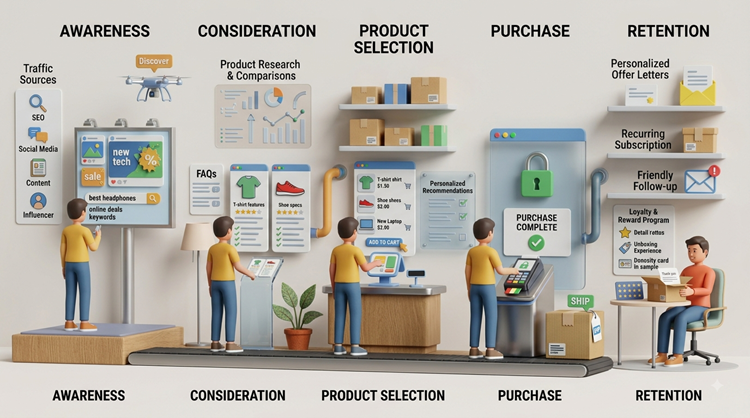
At the awareness stage, a chatbot can answer basic questions. During consideration, it can compare products or explain features. Near purchase, it can address checkout concerns. After the sale, it can support order-related questions.
This connected approach makes e-commerce marketing services more useful because automation supports several stages rather than functioning as a standalone website widget.
8. Build Better E-Commerce Marketing Strategies Around Customer Intent
Strong e-commerce marketing strategies begin with understanding what customers are trying to accomplish.
Instead of asking, “Where can we add a chatbot?” start with questions such as:
- Where do customers commonly get stuck?
- Which questions are repeated most often?
- Which product categories require the most guidance?
- Where do visitors abandon the buying journey?
- Which support requests could be resolved automatically?
- When does a customer need a human representative?
The answers can reveal the best opportunities for automation.
This customer-first approach also helps businesses use e-commerce marketing services more strategically, because technology is selected to solve genuine customer problems.
9. Improve Website SEO Alongside Conversational Experiences
Automation should support your website rather than replace useful content.
Product descriptions, category pages, buying guides, FAQs, and educational content still need to provide clear information for visitors and search engines.
Businesses focusing on seo for e-commerce websites should make sure important information remains accessible as crawlable website content rather than placing essential details exclusively inside a conversational interface.
Businesses looking to strengthen their organic visibility can also explore best e-commerce seo services to build a stronger search strategy alongside their chatbot and conversion efforts.
A strong organic search strategy and a helpful chatbot can work together. Search brings qualified visitors to the website, while the conversational experience can help those visitors find the right information or product.
Businesses evaluating their broader search strategy may also benefit from reviewing the 8 best e-commerce platforms for SEO before making technology decisions.
10. Use Customer Feedback to Improve Conversations
A chatbot should not be considered a set-it-and-forget-it feature.
Review conversations regularly to identify unanswered questions, confusing responses, repeated requests, and points where customers ask for human assistance.
These insights can reveal gaps in product information or website content.
Customer feedback can also strengthen other promotional efforts. For example, businesses exploring e-commerce growth with user-generated content can use recurring customer questions and concerns to identify topics that deserve authentic customer perspectives.
11. Track the Right Chatbot Metrics
Simply measuring how many conversations a chatbot handles does not tell you whether it is successful.
Track metrics that connect automation with actual business outcomes.
Useful measurements include:
- Conversation completion rate
- Product recommendation clicks
- Add-to-cart rate
- Checkout completion
- Cart recovery rate
- Customer satisfaction
- Human-agent escalation rate
- Average response time
- Conversion rate from chatbot-assisted sessions
These metrics can help determine whether e-commerce marketing services are producing meaningful improvements rather than simply generating more automated conversations.
12. Make the Experience Easy to Use
A technically advanced chatbot can still fail if customers find it frustrating.
Keep the opening message clear and give users obvious options. Avoid forcing visitors through long conversations before they can reach the information they need.
The interface should also work well on mobile devices because many online shoppers browse and purchase from smartphones.
Businesses should pay attention to broader user experience trends as well. Exploring the most important developments shaping online stores can help identify improvements that extend beyond conversational tools.
Choosing the Right Chatbot Strategy
The right solution depends on your business model, product complexity, customer expectations, and available resources.
A small retailer may only need automated answers for shipping, returns, product availability, and basic recommendations.
A larger online business may need deeper integrations with its product catalog, customer service platform, analytics tools, and customer relationship systems.
The important point is to start with a specific business problem instead of adopting automation simply because it is popular.
If your website also needs a stronger foundation for customer journeys, integrations, and conversion-focused experiences, unlimited web design can be considered as part of the wider website strategy.
Common Mistakes to Avoid
Several mistakes can reduce the effectiveness of chatbot automation.
Making Every Conversation a Sales Pitch
Customers may be looking for information, not an immediate sales offer. Helpful answers should come before promotional messages.
Hiding Human Support
Visitors should always have a clear way to reach a person when the issue is too complex for automation.
Using Outdated Information
Incorrect product details, shipping policies, or pricing can damage trust quickly. Keep chatbot information synchronized with current business data.
Ignoring Conversation Data
Unanswered questions and repeated escalations are valuable signals. Use them to improve the chatbot and the website itself.
Final Thoughts
Chatbots can make online shopping faster, more personalized, and easier to navigate when they are designed around genuine customer needs. From product discovery and support to cart recovery and lead qualification, there are several practical ways to integrate automation into a modern customer journey.
The strongest e-commerce marketing services strategies do not treat chatbots as a replacement for people. Instead, they use automation for repetitive interactions while giving human teams more time to handle conversations that require judgment, empathy, or expertise.
Start with one clear customer problem, measure the results, improve the experience, and expand gradually. With the right strategy, e-commerce marketing services can turn conversational automation into a useful part of the overall buying experience.
Frequently Asked Questions
1. Can chatbots increase online sales?
Yes, they can help increase sales by answering questions, recommending products, and reducing purchase friction.
2. Are chatbots useful for small e-commerce businesses?
Yes, small businesses can use them to automate common questions and provide support without expanding their teams.
3. Should a chatbot replace customer service agents?
No, chatbots should handle routine requests while human agents manage complex or sensitive conversations.
4. Can chatbots help recover abandoned carts?
Yes, they can remind shoppers about unfinished purchases and address common concerns that prevent checkout.
5. How should chatbot performance be measured?
Track metrics such as assisted conversions, completed conversations, customer satisfaction, and escalation rates.


