
 May 1, 2026
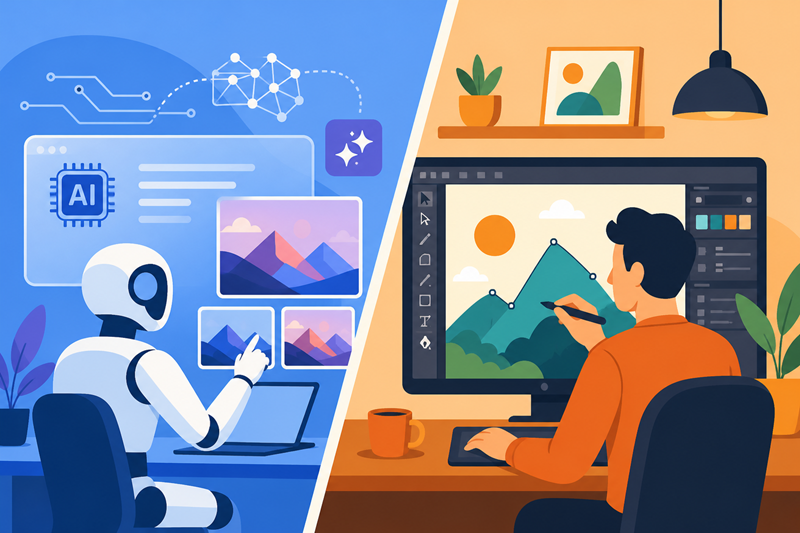
Design technology has changed rapidly over the last few years, and creative professionals are now balancing automation with traditional artistic methods. Businesses, marketers, and creators often ask the same question: how does AI-generated design compare to traditional vector illustration, and which one delivers better results?
The answer depends on the project, creative goals, and level of customization required. While AI tools can speed up workflows and generate concepts instantly, vector illustration remains the gold standard for precision, scalability, and originality. Understanding the difference helps brands make smarter creative decisions while building visuals that actually connect with audiences.
In this guide, we’ll break down the key differences between AI-driven design and traditional vector illustration, including workflow, quality, flexibility, branding value, and long-term usability.
Understanding AI-Driven Design
AI-driven design refers to visuals created or assisted by artificial intelligence systems. These tools analyze massive datasets, recognize design patterns, and generate layouts, illustrations, icons, or concepts based on prompts entered by users.
Instead of manually drawing every shape or object, designers can use AI to automate repetitive work or create rough concepts within seconds.
How AI Design Works
Most AI design platforms rely on machine learning models trained on large collections of artwork, layouts, photography, and typography. The system interprets prompts and predicts visual outcomes based on patterns it has learned.
For example, a user can request:
- A futuristic website layout
- A minimal logo concept
- A fantasy-style character illustration
- Social media graphics
The software then generates multiple versions almost instantly.
This speed is one reason many businesses are exploring AI-assisted creative production alongside modern unlimited web design solutions that prioritize faster turnaround and scalable content creation.
Common Uses of AI Design
AI-generated design is now commonly used for:
- Quick mockups
- Ad creatives
- Social media graphics
- Website wireframes
- Content ideation
- Automated branding assets
It works especially well when teams need high-volume output in limited timeframes.
What Is Traditional Vector Illustration?
Traditional vector illustration is a manual design process where artists create graphics using mathematical paths rather than pixels. Designers use tools like Adobe Illustrator or similar platforms to draw scalable artwork from scratch.
Unlike AI-generated outputs, vector illustrations are intentionally crafted by human artists with complete control over composition, style, detail, and brand identity.
How Vector Illustration Works
Vector graphics use anchor points, curves, and paths to build artwork that can scale infinitely without losing quality.
This makes vector illustration ideal for:
- Logos
- Brand assets
- Packaging
- Website icons
- Infographics
- Large-format printing
Because the artwork is editable at every level, designers can fine-tune even the smallest visual details.
Many professionals still rely heavily on advanced graphic design software to create polished illustrations that maintain quality across digital and print platforms.
The Core Difference Between AI Design and Vector Illustration
Although both approaches produce visual content, the creative process behind them is completely different.
AI Design Focuses on Automation
AI systems prioritize speed, prediction, and efficiency. They help users generate visuals quickly using existing data patterns.
The process is largely prompt-based:
- User enters instructions
- AI generates visuals
- User edits or selects outputs
This dramatically reduces production time but may limit originality.
Vector Illustration Focuses on Creative Precision
Traditional vector illustration emphasizes artistic intent and handcrafted design decisions.
The workflow usually involves:
- Sketching concepts
- Building vectors manually
- Refining shapes and composition
- Finalizing brand-consistent artwork
This process takes longer but delivers stronger creative ownership and customization.
Quality and Originality Comparison
One of the biggest differences between the two methods is originality.
AI Design Can Feel Repetitive
AI tools generate results based on patterns learned from existing artwork. While outputs may appear impressive initially, many designs share similar visual traits.
Over time, brands risk creating visuals that look generic or overly automated.
This is particularly important for companies trying to stand out in competitive industries where unique visual identity matters.
Vector Illustration Offers Unique Artistic Identity
Human illustrators make intentional creative choices based on brand personality, audience emotion, and storytelling goals.
That level of originality creates stronger brand recognition and emotional connection.
Companies focused on long-term growth often prioritize custom illustration because it supports stronger visual differentiation and more consistent branding across channels.
You can see how maintaining consistent branding strengthens audience trust and improves recognition over time.
Speed and Workflow Efficiency
AI design has a major advantage when it comes to production speed.
AI Delivers Faster Output
AI tools can generate:
- Multiple layouts
- Design variations
- Style concepts
- Backgrounds
- Draft visuals
within seconds.
This helps marketing teams accelerate campaigns and test creative ideas rapidly.
For startups or small businesses with limited resources, AI can reduce turnaround time significantly.
Vector Illustration Requires More Time
Creating custom vector artwork involves:
- Manual drawing
- Composition adjustments
- Color refinement
- Brand alignment
- Detail polishing
Because everything is handcrafted, the process naturally takes longer.
However, the tradeoff is higher-quality output tailored specifically to the brand’s needs.
Scalability and File Flexibility
Vector Graphics Scale Perfectly
One major strength of vector illustration is scalability.
Vector files can be resized from:
- Small mobile icons
to - Massive billboard graphics
without losing sharpness or clarity.
That flexibility makes vectors highly practical for businesses operating across multiple marketing channels.
AI Assets May Have Resolution Limits
AI-generated visuals are often raster-based images. This means enlarging them can reduce quality and create pixelation issues.
Some AI tools now support scalable exports, but they still may not offer the same precision as manually created vectors.
Creative Control and Editing
AI Has Limited Precision
Although AI platforms allow editing, users often face limitations when refining specific details.
Changing:
- Facial expressions
- Layout balance
- Object positioning
- Typography accuracy
can become frustrating if the AI system misunderstands instructions.
Vector Illustration Allows Full Customization
With vector artwork, every element remains editable.
Designers can precisely adjust:
- Shapes
- Colors
- Lines
- Gradients
- Typography
- Spacing
This level of control is critical for professional branding projects where consistency matters.
Cost Considerations
Cost often influences whether businesses choose AI tools or custom illustration services.
AI Tools Can Reduce Initial Costs
Subscription-based AI platforms are generally affordable and accessible.
Businesses can quickly create:
- Marketing visuals
- Basic graphics
- Concept art
without hiring a full design team.
This makes AI attractive for fast-paced content production.
Custom Vector Illustration Is an Investment
Hiring professional illustrators or working with an unlimited web design agency may cost more initially, but it often produces higher-quality brand assets with longer-term value.
Custom illustration contributes to:
- Brand recognition
- Professional credibility
- Visual uniqueness
- Marketing consistency
Over time, these benefits can outweigh the upfront investment.
Which Option Is Better for Branding?
The best choice depends on the purpose of the project.
AI Design Is Useful for:
- Rapid prototyping
- Temporary campaigns
- Social content
- Brainstorming concepts
- Internal mockups
Vector Illustration Is Better for:
- Logos
- Brand systems
- Product packaging
- Website illustrations
- Marketing campaigns
- Long-term identity design
Businesses focused on professional branding usually benefit more from custom vector-based creative work.
The Role of Human Creativity in Modern Design
AI can automate processes, but it cannot fully replace human creativity.
Design is not only about generating visuals. It also involves:
- Emotional storytelling
- Audience psychology
- Brand positioning
- Strategic communication
Human designers understand nuance, cultural context, and visual meaning in ways AI still struggles to replicate.
The strongest creative workflows today often combine AI efficiency with human artistic direction.
AI Design and Modern Digital Experiences
AI-generated visuals are increasingly used in interactive platforms, especially in web and app development.
This trend overlaps with technologies like progressive web apps, where businesses focus on fast, responsive, and visually engaging user experiences.
AI tools can assist with layout generation and interface concepts, while vector illustration helps create polished assets that maintain brand consistency across devices.
Together, these approaches support more dynamic digital experiences.
Learning Design Skills in the AI Era
As AI tools become more common, many aspiring creatives wonder whether traditional illustration skills still matter.
The answer is yes.
Understanding composition, typography, color theory, and visual storytelling remains essential even when using AI-assisted platforms.
A strong graphics design foundation helps creators:
- Evaluate AI outputs
- Improve visual quality
- Maintain originality
- Create brand-focused work
Likewise, enrolling in a professional graphics design course can help designers develop technical and creative skills that AI alone cannot replace.
Modern designers increasingly combine manual creativity with automation to stay competitive.
The Future of AI and Vector Illustration
AI-driven creativity will continue evolving, but traditional illustration is unlikely to disappear.
Instead, the industry is moving toward hybrid workflows where:
- AI speeds up production
- Designers refine concepts
- Artists add originality and emotion
Brands that balance efficiency with authentic creativity will stand out most in the coming years.
Rather than replacing artists, AI is becoming another tool in the creative process.
Final Thoughts
AI-driven design and traditional vector illustration serve very different purposes. AI excels at speed, automation, and idea generation, while vector illustration delivers originality, scalability, and precise creative control.
Businesses looking for fast content production may benefit from AI-assisted workflows. However, companies focused on strong branding, professional quality, and unique visual identity still rely heavily on custom illustration work.
The smartest approach is often a combination of both — using AI for efficiency while allowing human creativity to shape the final result.
FAQs
Is AI-generated design better than vector illustration?
AI is faster for concept generation, while vector illustration offers better originality and precision.
Can AI replace graphic illustrators?
AI can assist designers, but human creativity and strategic thinking remain essential.
Why are vector graphics important for branding?
Vector graphics scale perfectly and maintain consistent quality across all platforms.
Are AI-generated designs copyrighted?
Copyright rules vary by platform and region, so businesses should review licensing terms carefully.
Which industries benefit most from vector illustration?
Branding, packaging, advertising, publishing, and web design industries heavily rely on vector illustration.