
 June 16, 2026
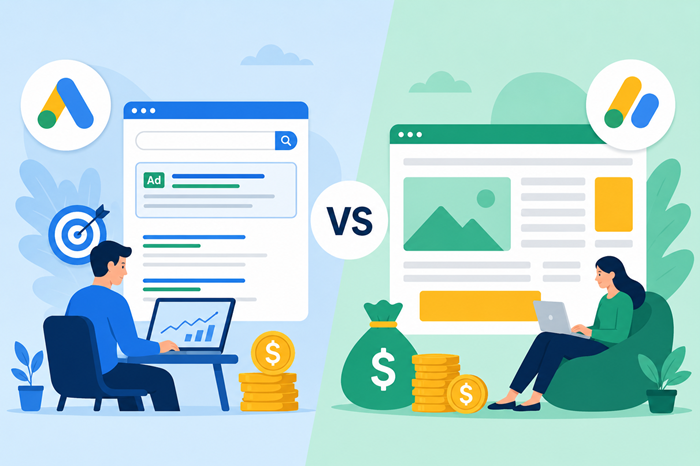
When people start exploring online advertising, two Google platforms often come up first: Google PPC and AdSense. Although both are part of Google’s advertising ecosystem, they serve completely different purposes.
Many business owners, marketers, and website publishers mistakenly assume they are interchangeable. In reality, understanding the difference between these platforms can significantly impact your advertising results, revenue potential, and overall digital marketing strategy.
If you’re trying to decide whether to invest in paid search advertising or monetize website traffic, this guide will explain exactly how Google PPC and AdSense work, their benefits, and which option makes the most sense for your goals.
What Is Google PPC?
Google PPC (Pay-Per-Click) is an advertising model where businesses pay each time someone clicks on their advertisement.
Through Google Ads, advertisers can display their ads across Google’s search results, partner websites, YouTube, and other properties. The goal is straightforward: drive targeted traffic, generate leads, increase sales, or build brand awareness.
For businesses looking to maximize campaign performance, professional ppc services can help optimize budgets, targeting, and conversions.
How Google PPC Works
The process follows a simple structure:
- Advertisers create campaigns.
- They choose target keywords.
- Google runs an auction whenever users search.
- Ads appear based on relevance and bid competitiveness.
- Advertisers pay only when someone clicks.
This model gives businesses control over spending while providing measurable results.
Key Benefits of Google PPC
- Immediate visibility in search results
- Highly targeted audience reach
- Flexible budget control
- Detailed performance tracking
- Faster lead generation compared to organic SEO
Because campaigns can be adjusted in real time, many companies use paid search as a reliable growth channel.
What Is Google AdSense?
Google AdSense is a website monetization platform designed for publishers.
Instead of paying for clicks, website owners earn money by displaying ads on their websites. Google automatically matches relevant advertisements to the site’s content and visitors.
Whenever users view or click these ads, publishers receive a portion of the advertising revenue.
How AdSense Works
The process is simple:
- Website owners join AdSense.
- Ad code is placed on web pages.
- Google serves relevant ads automatically.
- Visitors interact with those ads.
- Publishers earn revenue.
AdSense is especially popular among bloggers, news websites, niche content creators, and informational websites with consistent traffic.
Key Benefits of AdSense
- Passive revenue generation
- Easy implementation
- Automatic ad management
- Access to Google’s advertiser network
- Multiple ad formats and placements
For content-driven websites, AdSense can create an additional income stream without directly selling products or services.
The Fundamental Difference Between Google PPC and AdSense
The simplest way to understand the difference is this:
Google PPC helps businesses buy traffic.
Google AdSense helps publishers monetize traffic.
One platform focuses on spending money to attract visitors, while the other focuses on earning money from existing visitors.
Side-by-Side Comparison
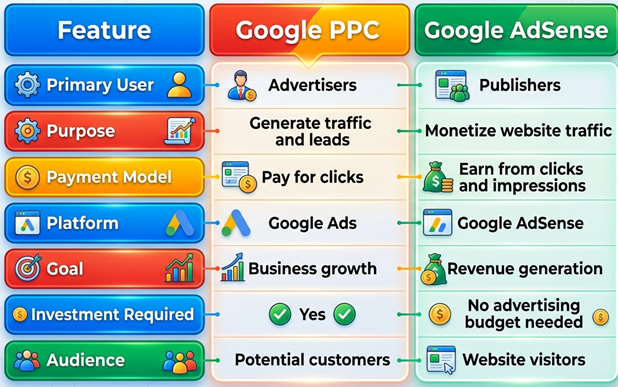
This distinction is essential when building an online marketing strategy.
Who Should Use Google PPC?
Google PPC is ideal for businesses that want immediate visibility and measurable growth.
Companies launching new products, promoting services, or competing in crowded markets often benefit from paid advertising because results can appear much faster than organic SEO efforts.
Businesses That Benefit Most
- Local service providers
- E-commerce stores
- SaaS companies
- Professional service firms
- B2B organizations
- Startups seeking rapid growth
Many organizations partner with a specialized ppc agency to improve campaign efficiency and maximize return on investment.
When PPC Makes Sense
PPC is particularly valuable when:
- You need leads quickly
- Organic rankings are still developing
- Competition is intense
- Seasonal promotions require immediate exposure
- You want precise audience targeting
A carefully planned advertising strategy can often deliver results within days rather than months.
Who Should Use AdSense?
AdSense is designed for website owners who already attract regular traffic.
If your site receives visitors through search engines, social media, email marketing, or direct traffic, AdSense can help convert that audience into revenue.
Websites That Commonly Use AdSense
- Blogs
- News portals
- Educational websites
- Niche authority sites
- Forums
- Entertainment websites
The more qualified traffic a site attracts, the greater its earning potential.
When AdSense Makes Sense
AdSense works best when:
- You have substantial website traffic
- Content is published consistently
- Visitors engage with pages regularly
- Monetization options are limited
- You want a low-maintenance revenue source
Publishers can generate income without creating products or managing customer relationships.
Cost Structure: Paying vs Earning
One of the most important distinctions is financial direction.
With PPC advertising, businesses invest money upfront to attract visitors and convert them into customers.
With AdSense, publishers earn money from advertisers whose ads appear on their websites.
PPC Costs
Advertising expenses depend on:
- Industry competition
- Keyword demand
- Geographic targeting
- Ad quality
- Bid strategy
Proper ppc management helps reduce wasted spend while improving campaign performance.
AdSense Revenue
Publisher earnings depend on:
- Traffic volume
- Audience location
- Industry niche
- User engagement
- Ad placement quality
Revenue varies significantly between websites, making optimization important for long-term success.
Which Platform Generates Better ROI?
The answer depends entirely on your objective.
If your goal is acquiring customers, PPC generally provides stronger business ROI because it directly drives conversions.
If your goal is monetizing content, AdSense offers a scalable revenue opportunity without selling products or services.
For Businesses
A well-executed ppc marketing strategy can generate qualified leads, increase sales, and accelerate growth.
The key is ensuring campaigns target the right audience with compelling offers.
For Publishers
AdSense can create recurring income from existing traffic, especially when supported by high-quality content and strong organic visibility.
Success depends largely on audience size and engagement levels.
Can You Use PPC and AdSense Together?
Yes, and many successful companies do.
For example, a content website may run AdSense ads to earn revenue while simultaneously using paid advertising to promote premium products, services, or lead-generation pages.
This combination creates both revenue generation and customer acquisition opportunities.
Businesses often improve results by implementing proven ppc campaign strategies that align advertising efforts with broader business goals.
Common Misconceptions About PPC and AdSense
“They Are the Same Platform”
They are connected through Google’s advertising ecosystem but serve opposite functions.
Advertisers buy traffic through Google Ads, while publishers earn revenue through AdSense.
“AdSense Makes Money Instantly”
Revenue depends on traffic quality and volume. New websites often require time before meaningful earnings appear.
“PPC Guarantees Sales”
Paid clicks do not automatically create customers. Landing page quality, targeting, and messaging all influence performance.
Improving conversion rates often starts with building smarter ppc landing pages that align with visitor intent.
“Higher Budgets Always Win”
Google rewards relevance and user experience, not just spending. Well-optimized campaigns can outperform larger competitors.
How to Choose Between PPC and AdSense
The decision comes down to your business model.
Choose PPC if you want:
- More leads
- More customers
- More sales
- Faster growth
- Greater visibility
Choose AdSense if you want:
- Website monetization
- Passive income opportunities
- Revenue from content traffic
- Minimal advertising management
In some cases, businesses benefit from using both approaches strategically.
Before scaling campaigns, it’s also important to learn how to stop wasting ppc budget from ghost conversions, ensuring every advertising dollar contributes to meaningful results.
Building a Stronger Digital Marketing Foundation
Whether you’re advertising products or monetizing content, success depends on the quality of your online presence.
A professionally designed website improves user trust, engagement, and conversion rates. Many growing brands invest in unlimited web design solutions to ensure their websites support both marketing and monetization goals.
Strong design, quality content, and effective advertising work together to create sustainable growth.
Conclusion
Google PPC and AdSense may operate within the same advertising ecosystem, but they serve entirely different purposes.
PPC helps businesses attract targeted visitors by paying for clicks, while AdSense allows publishers to earn revenue from website traffic by displaying advertisements.
If your goal is acquiring customers and generating leads, PPC is the better choice. If your goal is monetizing content and website visitors, AdSense is the right solution.
Understanding these differences allows businesses and publishers to make smarter marketing decisions, allocate resources effectively, and maximize the value of their online presence.
FAQs
Is Google PPC the same as Google AdSense?
No, PPC is for advertisers buying traffic, while AdSense is for publishers earning from traffic.
Can I use Google PPC and AdSense together?
Yes, many websites use both for traffic generation and monetization.
Which is better for a business owner?
PPC is generally better for generating leads and sales.
Does AdSense require a large amount of traffic?
Higher traffic usually increases earning potential, but approval does not require massive traffic.
Is Google Ads connected to AdSense?
Yes, advertisers use Google Ads, and some of those ads appear on AdSense publisher websites.