
 June 17, 2026
In today’s digital-first economy, businesses are under constant pressure to deliver fast, seamless, and cost-effective digital experiences. As customer expectations rise and development costs continue to increase, many organizations are rethinking their mobile strategies. One solution gaining significant momentum is Progressive Web Apps (PWAs).
The shift toward pwa trends 2026 is not just a temporary movement. Enterprises across industries are increasingly replacing traditional native applications with web-based alternatives that offer flexibility, lower maintenance costs, and broader accessibility. From retail and finance to healthcare and logistics, companies are discovering that modern web technology can provide many of the same benefits as native apps without the associated complexity.
This article explores why enterprises are making the switch, the advantages driving adoption, and the critical developments shaping the future of PWAs.
Understanding Progressive Web Apps
Before exploring the trends, it’s important to understand what makes PWAs unique.
progressive web apps combine the best aspects of websites and mobile applications. They run through a browser while delivering app-like experiences such as offline functionality, push notifications, fast loading speeds, and home screen installation.
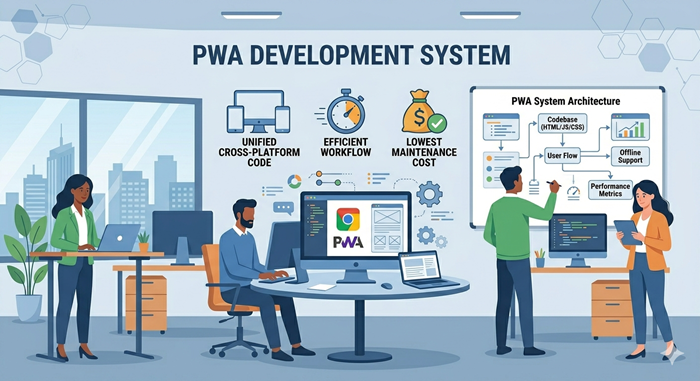
Unlike native apps that require separate development for iOS and Android, PWAs use a single codebase that works across multiple devices and operating systems. This significantly reduces development and maintenance efforts while maintaining a high-quality user experience.
As enterprises seek more efficient ways to engage customers, PWAs are becoming a strategic technology investment rather than just an alternative development approach.
Why Enterprises Are Moving Away from Native Apps
Rising Development and Maintenance Costs
Building native applications typically requires separate teams, codebases, testing processes, and update cycles for each platform.
As applications become more sophisticated, costs increase rapidly. Organizations looking to optimize budgets often discover that maintaining multiple native apps consumes resources that could be better allocated elsewhere.
PWAs eliminate much of this duplication by enabling a unified development strategy across platforms.
Businesses evaluating their digital investments often compare overall development expenses against expected returns. Understanding the true web development price can help decision-makers determine whether maintaining multiple native apps remains financially practical.
Faster Deployment Cycles
Enterprise software requirements evolve quickly. New features, security updates, and customer feedback often require immediate action.
With native applications, updates typically depend on app store approval processes and user downloads. PWAs allow updates to be deployed instantly, ensuring all users access the latest version without additional steps.
This speed creates a competitive advantage, particularly in industries where customer expectations change rapidly.
Improved Cross-Platform Reach
One of the biggest limitations of native applications is platform fragmentation.
PWAs provide a consistent experience across desktops, tablets, and smartphones without requiring separate installations. This expanded reach allows businesses to engage more users while simplifying development and support efforts.
For organizations targeting diverse customer bases, cross-platform accessibility has become a major strategic priority.
The Business Benefits Driving PWA Adoption
Reduced Time to Market
Launching a native application can take months of planning, development, testing, and optimization.
PWAs streamline this process significantly. Enterprises can launch faster, test ideas more efficiently, and respond quickly to changing market demands.
This agility is especially valuable for companies introducing new products, services, or customer experiences.
Better User Acquisition
Many users hesitate to download an app before experiencing its value.
PWAs remove this barrier by allowing users to access functionality directly through a browser. Customers can engage immediately without visiting an app store or consuming device storage.
The result is often improved conversion rates and higher customer engagement.
Lower Infrastructure Complexity
Managing multiple development pipelines increases operational complexity.
A unified PWA approach simplifies deployment, maintenance, quality assurance, and analytics management. IT teams benefit from streamlined workflows while businesses reduce long-term technical debt.
Stronger ROI
Because PWAs typically require fewer resources to build and maintain, enterprises often achieve a better return on investment.
Organizations can allocate savings toward innovation, marketing, customer experience improvements, or expansion initiatives rather than maintaining duplicate development environments.
Critical PWA Trends Shaping Enterprise Decisions
Enhanced Offline Experiences
Offline functionality has become increasingly sophisticated.
Modern PWAs can store data locally, allowing users to continue interacting with applications even when connectivity is limited. This capability is especially valuable for field teams, remote workers, logistics operations, and global enterprises.
As connectivity challenges persist in many regions, offline reliability remains a significant competitive advantage.
Advanced Push Notification Strategies
Push notifications were once considered exclusive to native applications.
Today’s PWAs offer increasingly robust notification capabilities, enabling businesses to improve engagement, drive conversions, and maintain customer relationships without requiring app installations.
As notification technologies continue to evolve, enterprise adoption is expected to accelerate further.
AI-Powered Personalization
Artificial intelligence is transforming digital experiences.
PWAs are increasingly incorporating personalized recommendations, predictive search, automated support systems, and dynamic content delivery. These enhancements create highly tailored experiences that improve user satisfaction and retention.
The combination of AI and modern web technology is becoming a major differentiator for enterprise applications.
Improved Device Integration
Historically, limited hardware access was viewed as a disadvantage for web applications.
However, browser capabilities continue to expand. Modern PWAs can increasingly interact with cameras, microphones, geolocation services, and other device features.
This evolution is narrowing the gap between native and web-based experiences, making PWAs more attractive for enterprise use cases.
Performance as a Competitive Advantage
Faster Load Times
Speed directly impacts customer satisfaction and business outcomes.
Research consistently shows that users abandon slow digital experiences. PWAs leverage modern caching techniques and optimized architectures to deliver faster performance, even under challenging network conditions.
Improved speed can lead to higher engagement, better conversion rates, and stronger customer retention.
Better Mobile Experiences
Mobile traffic now dominates many industries.
Businesses are investing heavily in mobile web apps for business because they provide responsive, app-like experiences without requiring users to install software.
For enterprises focused on customer acquisition and retention, delivering a seamless mobile experience is no longer optional.
Enhanced Security
Security remains a top concern for enterprise technology leaders.
PWAs operate through HTTPS, providing encrypted communication and reducing risks associated with insecure connections. Combined with modern authentication methods and continuous updates, this creates a secure foundation for enterprise applications.
How PWAs Support Digital Transformation
Digital transformation initiatives require flexibility, scalability, and operational efficiency.
PWAs align naturally with these objectives by reducing development complexity while improving customer experiences. Organizations can modernize legacy systems, launch new digital services, and expand into new markets more efficiently.
Companies seeking scalable digital solutions often explore unlimited web design models to accelerate ongoing improvements and maintain consistent user experiences across multiple platforms.
As digital transformation efforts continue worldwide, PWAs are becoming a foundational technology strategy rather than a niche solution.
Industries Leading the Shift
Retail and E-Commerce
Retailers use PWAs to improve shopping experiences, increase conversion rates, and reduce friction throughout the customer journey.
Features such as offline browsing, personalized recommendations, and instant loading times contribute to stronger sales performance.
Financial Services
Banks and financial institutions prioritize accessibility, security, and reliability.
PWAs help organizations deliver essential services while reducing development costs and simplifying platform management.
Healthcare
Healthcare providers increasingly rely on digital tools for patient engagement, scheduling, telehealth, and information access.
PWAs offer flexible deployment options while supporting secure and responsive user experiences.
Logistics and Transportation
Field operations often require reliable performance in areas with inconsistent connectivity.
Offline capabilities make PWAs particularly valuable for logistics companies managing complex workflows and distributed teams.
The Growing Relevancy of PWAs
The conversation around modern web applications has evolved significantly over the past few years.
Many industry experts who once questioned the long-term viability of PWAs now recognize the growing relevancy of PWA as browser technologies continue to mature and enterprise adoption expands.
What was once viewed as an emerging technology is increasingly becoming a mainstream business solution.
Development Trends Enterprises Should Watch
Unified Application Strategies
Organizations are increasingly consolidating web and mobile experiences into single platforms.
This reduces maintenance overhead while creating more consistent customer journeys across devices.
Headless Architectures
Headless development approaches pair exceptionally well with PWAs.
By separating frontend and backend systems, enterprises gain greater flexibility, scalability, and content management capabilities.
Faster Development Frameworks
Modern frameworks are making PWA development faster and more efficient than ever before.
Teams evaluating the fastest frameworks to build a full stack web app often prioritize performance, scalability, and developer productivity to support enterprise-level applications.
These tools are helping businesses launch sophisticated web experiences with greater speed and lower costs.
Portfolio-Driven Innovation
As demand for modern web applications grows, developers are continuously experimenting with new concepts and technologies.
Many aspiring engineers sharpen their skills by building projects inspired by these 10 full stack web app ideas, contributing to a larger ecosystem of innovation that ultimately benefits enterprise adoption.
Challenges Enterprises Must Consider
While PWAs offer substantial advantages, successful implementation still requires careful planning.
Organizations should evaluate:
- Browser compatibility requirements
- Security and compliance needs
- Offline data synchronization strategies
- User experience expectations
- Integration with existing enterprise systems
Addressing these factors early helps maximize long-term success and ensures smooth deployment.
The Future of Enterprise Applications
The evolution of progressive web apps pwa trends indicates a broader shift in how businesses approach software development.
Rather than maintaining separate ecosystems for web and mobile experiences, enterprises are increasingly embracing unified solutions that deliver efficiency, scalability, and exceptional user experiences.
As browser capabilities continue to improve, the distinction between native and web applications will become even less significant.
Organizations that adapt early will be positioned to reduce costs, accelerate innovation, and meet growing customer expectations more effectively.
Conclusion
Enterprises are not abandoning native applications simply because PWAs are cheaper. They are making strategic decisions based on performance, scalability, maintenance efficiency, and user experience.
The ongoing evolution of pwa trends demonstrates how web technologies have matured into enterprise-grade solutions capable of supporting complex business requirements. With faster deployment cycles, lower operational costs, improved accessibility, and expanding device capabilities, PWAs offer compelling advantages for modern organizations.
As businesses continue investing in web apps development services, Progressive Web Apps are expected to play an increasingly important role in digital transformation strategies. The companies that understand and embrace this shift today will be better prepared for tomorrow’s competitive landscape.
Frequently Asked Questions
1. Why are enterprises replacing native apps with PWAs?
PWAs reduce development costs while providing cross-platform accessibility and strong performance.
2. Do PWAs work offline?
Yes, modern PWAs can function offline using cached resources and stored data.
3. Are PWAs secure for enterprise use?
Yes, PWAs use HTTPS and modern security standards to protect user data.
4. Can PWAs send push notifications?
Yes, most modern browsers support push notifications for PWAs.
5. Are PWAs suitable for e-commerce businesses?
Yes, PWAs often improve mobile performance, engagement, and conversion rates.