
 June 24, 2026
The world of online retail moves fast. Every year brings a new wave of design ideas, customer experience innovations, and technology-driven promises. As businesses prepare for the future, many are asking which e-commerce ux trends 2026 will genuinely improve conversions and customer satisfaction—and which ones are simply generating buzz.
The reality is that not every trend deserves a place on your website. Some innovations create measurable business value, while others add complexity without improving the shopping experience.
In this guide, we’ll break down the most important developments shaping online stores in 2026, identify what’s worth implementing, and highlight the trends businesses should approach with caution.
Why User Experience Will Matter More Than Ever in 2026
Consumer expectations continue to rise. Shoppers want websites that load instantly, help them find products quickly, and make purchasing effortless across every device.
Businesses that prioritize customer experience often see benefits such as:
- Higher conversion rates
- Improved customer retention
- Lower cart abandonment
- Increased average order value
- Stronger brand loyalty
While new technologies attract attention, the fundamentals remain unchanged: customers reward websites that are easy to use.
Many companies investing in e-commerce website design improvements are discovering that small usability enhancements often outperform flashy features.
What’s Actually Worth Implementing in 2026
Let’s start with the trends delivering real-world results.
AI-Powered Personalization That Feels Helpful
Artificial intelligence is no longer a novelty. In 2026, the most successful online stores use AI to simplify decision-making rather than overwhelm customers.
Effective personalization includes:
- Relevant product recommendations
- Dynamic category suggestions
- Personalized search results
- Smart upsell opportunities
The key difference is subtlety. Customers appreciate recommendations that solve problems rather than aggressive attempts to increase cart value.
Businesses focused on sustainable growth should prioritize practical AI applications that improve the shopping journey.
Smarter On-Site Search Experiences
Search functionality has become one of the most influential conversion drivers.
Modern search tools can now:
- Understand natural language
- Interpret misspellings
- Recognize customer intent
- Suggest related products
A shopper searching for “comfortable office chair for back pain” expects meaningful results, not a list of random chairs.
As product catalogs grow larger, intelligent search becomes increasingly valuable.
Faster Mobile Shopping Journeys
Mobile commerce continues to dominate online purchasing behavior.
Successful brands are reducing friction by:
- Simplifying navigation
- Minimizing checkout steps
- Improving page performance
- Optimizing touch interactions
Speed remains one of the strongest conversion factors. Even minor delays can negatively affect revenue.
Companies investing in mobile-first experiences are positioning themselves for long-term growth.
Visual Product Discovery
Customers increasingly prefer visual exploration over traditional browsing.
Features gaining traction include:
- Image-based search
- Interactive product galleries
- 360-degree product views
- User-generated content integration
Visual discovery helps shoppers evaluate products more confidently, reducing uncertainty before purchase.
This trend is especially valuable for fashion, furniture, beauty, and lifestyle brands.
Accessibility as a Competitive Advantage
Accessibility is moving beyond compliance requirements.
Businesses are recognizing that accessible websites serve a broader audience while creating better experiences for everyone.
Practical improvements include:
- Improved color contrast
- Keyboard navigation support
- Descriptive image alt text
- Readable typography
Accessibility enhancements often improve usability across all customer segments.
UX Trends That Are Mostly Hype
Not every emerging trend deserves immediate adoption.
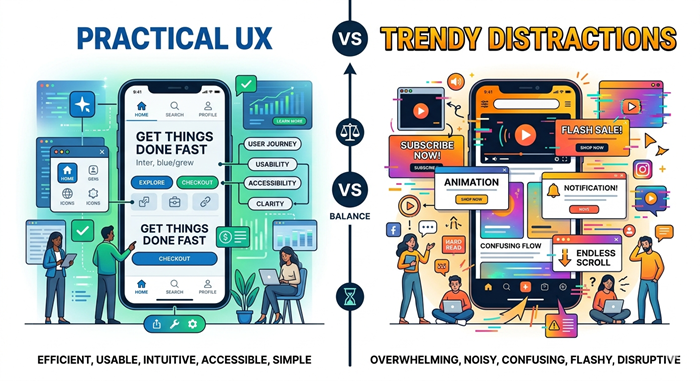
Excessive AI Chatbots
AI assistants can provide value when used strategically.
However, many websites now deploy chatbots that interrupt visitors before they have a chance to browse.
Common problems include:
- Popups appearing instantly
- Irrelevant recommendations
- Repetitive automated responses
- Difficulty reaching human support
Customers want assistance when they need it—not constant interruptions.
Overly Complex Animations
Animations can improve engagement when used thoughtfully.
Unfortunately, some websites prioritize visual effects over usability.
Heavy animations often lead to:
- Slower loading times
- Navigation distractions
- Reduced accessibility
- Mobile performance issues
Good design supports user goals rather than competing for attention.
Virtual Reality Shopping for Every Store
Virtual reality has legitimate applications in certain industries.
Furniture retailers, home improvement brands, and luxury products may benefit from immersive experiences.
For most businesses, however, VR remains expensive to implement and delivers limited return on investment.
Before investing heavily, brands should ensure their core shopping experience is already optimized.
Trend-Driven Redesigns Without User Research
One of the biggest mistakes businesses make is redesigning websites solely because a design trend appears popular.
Successful redesigns should be based on:
- Customer feedback
- Conversion data
- User testing
- Behavioral analytics
Following trends without understanding customer needs can easily reduce performance.
The Growing Importance of Simplicity
The most successful digital experiences in 2026 share one common characteristic: simplicity.
Consumers face endless choices online. Websites that reduce complexity tend to outperform those attempting to impress visitors with excessive features.
Key areas where simplicity wins include:
Streamlined Navigation
Customers should find products within seconds.
Clear categories, logical menu structures, and intuitive filtering systems help users move efficiently through the buying process.
Cleaner Product Pages
Product pages work best when they focus on information customers actually need.
Important elements include:
- High-quality images
- Clear pricing
- Honest descriptions
- Shipping information
- Customer reviews
Everything else should support these core objectives.
Frictionless Checkout Experiences
Checkout remains one of the most critical stages of the buyer journey.
Businesses seeing strong results are reducing checkout friction through:
- Guest checkout options
- Express payment methods
- Fewer form fields
- Transparent shipping costs
Every unnecessary step creates an opportunity for abandonment.
How Technical Performance Supports Better UX
User experience isn’t only visual.
Technical performance plays a major role in customer satisfaction and search visibility.
Businesses looking to strengthen online sales should pay close attention to page speed, site architecture, structured data, and crawlability. These are among the most important technical seo tactics that drive more e-commerce sales because they directly impact both users and search engines.
A fast, technically sound website creates a foundation that supports every other UX improvement.
Building Future-Ready Online Stores
Many businesses become distracted by emerging technologies and overlook foundational improvements.
Instead of chasing every trend, focus on creating a store that is:
- Fast
- Accessible
- Mobile-friendly
- Easy to navigate
- Conversion-focused
Whether you’re launching a new store or improving an existing one, understanding how to build an e-commerce site that sells can help prioritize investments that deliver measurable results.
The goal isn’t to have the most innovative website. The goal is to create the easiest path from discovery to purchase.
Choosing the Right Design and Development Approach
Implementing meaningful UX improvements requires the right expertise.
Many businesses struggle to decide between hiring independent professionals or working with specialized agencies. Understanding the differences between freelancer vs agency options can help determine which solution aligns best with project complexity, timelines, and long-term goals.
The best choice depends on business size, growth objectives, and available resources.
How Ducky Unlimited Helps Businesses Adapt to 2026 UX Changes
Keeping up with changing customer expectations can be challenging.
Through its unlimited web design model, Ducky Unlimited helps businesses continuously improve their websites without the delays and unpredictability often associated with traditional design projects.
From conversion-focused user experience enhancements to ongoing design updates, businesses can adapt more quickly as customer behaviors evolve.
For brands planning future website improvements, evaluating available e-commerce pricing options can help determine the most cost-effective path toward ongoing optimization.
The Future of UI and UX: Focus on Customer Outcomes
Many businesses become obsessed with predicting the next big innovation.
The truth is that the most effective ui ux trends often revolve around solving familiar customer problems more efficiently.
The websites that thrive in 2026 won’t necessarily have the most advanced technology. They’ll be the ones that make shopping feel effortless.
Similarly, choosing the right e-commerce website builder matters less than how effectively the platform supports speed, usability, scalability, and customer needs.
When evaluating new trends, a simple question can guide decision-making:
Does this feature genuinely help customers accomplish their goals faster and more confidently?
If the answer is yes, it’s worth considering.
If not, it’s probably hype.
Conclusion
As online retail continues evolving, businesses face constant pressure to adopt new technologies and design approaches. However, not every trend deserves immediate implementation.
The most valuable investments for 2026 include AI-powered personalization, intelligent search, mobile optimization, visual product discovery, accessibility improvements, and streamlined purchasing experiences.
At the same time, businesses should remain cautious about overusing chatbots, excessive animations, expensive virtual reality projects, and redesigns driven purely by trends.
Success in modern e-commerce comes from balancing innovation with practicality. Companies that focus on customer needs rather than industry hype will be better positioned to increase conversions, strengthen loyalty, and achieve sustainable growth.
Frequently Asked Questions
1. What are the most important UX priorities for online stores in 2026?
Mobile optimization, personalization, accessibility, site speed, and simplified checkout experiences.
2. Is AI personalization worth implementing?
Yes, when it improves product discovery and customer decision-making without becoming intrusive.
3. Are chatbots still effective for e-commerce websites?
They can be useful when providing genuine support, but excessive chatbot interruptions often hurt user experience.
4. Does website speed still affect conversions?
Yes, faster websites consistently improve engagement, conversions, and search visibility.
5. Should businesses redesign their websites to follow every trend?
No, redesign decisions should be based on user data, business goals, and customer needs rather than trends alone.